# C_THR86_2605 AI Roleplay Scenario Questions: Answer Quality and Performance Guide
## Quick Summary
AI-guided SAP compensation assessments reward clear, technically accurate explanations over memorized definitions. Practice identifying the business need, investigating before acting, recommending a fitting solution, and confirming the result.
## Introduction
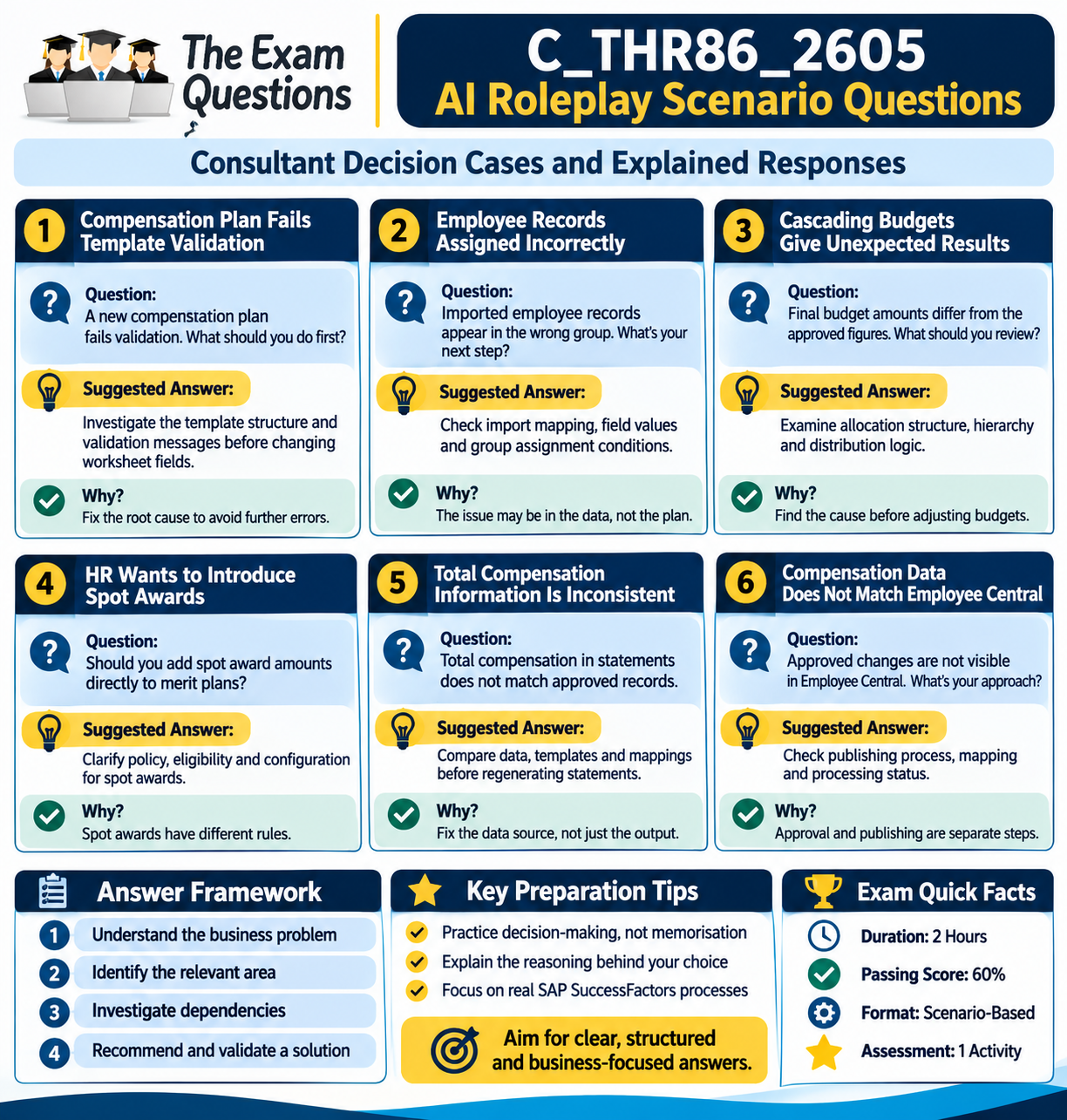
Knowing the right SAP feature forms only half of a strong answer, because a consultant also explains why the feature applies, what to investigate, and how the solution meets the business requirement. Imagine an HR manager reporting unexpected compensation recommendations: a consultant who jumps to a guideline change may miss other causes, such as employee data or salary information, and that habit of investigating first sits at the center of [C_THR86_2605 AI Roleplay Scenario Questions](https://theexamquestions.com/course/c-thr86-sap-exam-questions). Practice material works best alongside independent exercises where you explain decisions in your own words and adapt when the interviewer adds new information. This guide covers how SAP evaluates roleplay answers, a five-step framework, weak-versus-improved answer examples, follow-up handling, and a self-review method.
## What the roleplay assessment expects
SAP offers an AI-guided virtual interview as the recommended option for this scenario-based certification assessment, and candidates may choose a recorded-video submission for evaluation by an SAP assessor instead. The current listing shows a two-hour assessment, a 60% passing score, and one scenario-based activity.
SAP's evaluation relies on semantic understanding: the AI weighs the meaning and relevance of a response over the presence of particular keywords. Individual objectives are graded against expert-defined criteria from 1 (Insufficient) to 5 (Excellent).
Practice feedback and official scoring serve different purposes. SAP's AI roleplay practice tool gives feedback on clarity, relevance, completeness, correct terminology, and adherence to the expected process. These practice scores support improvement and sit apart from the official certification score, so use them as coaching and verify technical points against current SAP guidance.
## A framework for strong answers
**Understand the business context.** Identify what the organization wants to achieve before touching any setting. If a company wants to exclude an employee group from a salary review, establish who is affected and why.
**Identify the relevant functionality.** Choose the configuration area involved: plans, eligibility rules, guidelines, budgets, worksheets, permissions, or Employee Central integration. Mention only features that serve the situation.
**Explain the investigation.** Say which information you check first. For an eligibility issue, that includes employee status, effective dates, employee-specific data, and the configured conditions.
**Recommend a suitable action.** Tie the correction to the business requirement and consider effects on other employees, managers, and processes.
**Confirm the result.** Describe validation: sample records, worksheet results, approval behavior, or a comparison of approved values with published employee information.
## Improving weak answers
<iframe width="560" height="315" src="https://www.youtube.com/embed/0Sw2hKUlON4?si=WWXwIuT5gmOWOx-h" title="YouTube video player" frameborder="0" allow="accelerometer; autoplay; clipboard-write; encrypted-media; gyroscope; picture-in-picture; web-share" referrerpolicy="strict-origin-when-cross-origin" allowfullscreen></iframe>
These original practice situations work as study material and differ from actual SAP exam content.
### Employee eligibility
**Interviewer:** Several employees are missing from their compensation worksheets. What do you investigate?
**Weak:** I would check the eligibility settings and make the employees eligible.
**Improved:** I review the affected employee records, including employment status and effective dates, then examine the eligibility conditions configured for the plan and compare the affected employees with those correctly included. After finding the cause, I test the correction with representative records.
**Why it improves:** it links employee data with plan configuration and ends with validation.
### Budget discrepancy
**Interviewer:** Worksheet budgets differ from approved departmental amounts. How do you approach this?
**Weak:** I would increase the budget or update the allocation.
**Improved:** I compare configured allocations with the approved departmental requirements and review the employee population, organizational structure, and budget calculations. Once I find the source of the difference, I test the corrected allocation before applying it across the planning population.
**Why it improves:** it replaces an unsupported financial change with an organized process.
### Worksheet approval
**Interviewer:** A manager edits a worksheet and cannot submit it for approval. What do you check?
**Weak:** I would give the manager more permissions.
**Improved:** I review the worksheet status, the manager's role-based permissions, the route-map configuration, and open validation requirements, and I decide whether access settings or the approval process creates the restriction. Then I test the submission to confirm the worksheet reaches the correct approval stage.
**Why it improves:** it separates permissions from workflow configuration.
### Compensation statement
**Interviewer:** Statements show amounts that differ from approved worksheet results. What is your response?
**Weak:** I would regenerate the statements.
**Improved:** I compare approved figures with the statement content and check employee data, compensation components, field configuration, and currency presentation. After correcting the underlying issue, I validate a sample statement before distribution.
**Why it improves:** it targets the source, since regeneration alone may repeat the same error.
### Employee Central publishing
**Interviewer:** Approved salary changes are absent in Employee Central. How do you investigate?
**Weak:** I would run the publishing process again.
**Improved:** I confirm the approval process is complete, then examine publishing status, field mappings, effective dates, and processing messages, and compare approved results with the resulting employee records to locate where the process stopped.
**Why it improves:** it separates approval from publishing and explains verification.
## Handling follow-up questions
An interviewer may add information after your first answer. Reconsider the situation instead of repeating yourself. Suppose you investigate missing employees and learn that the management hierarchy recently changed: consider whether new manager relationships affect worksheet ownership, employee populations, or approval responsibilities. When a budget discrepancy touches only one department, examine department-specific conditions before questioning the whole plan. Acknowledge the new detail, explain how it shifts your investigation, and adjust your recommendation.
## A personal review method
After each practice session, rate yourself from 1 to 5 on these areas:
| Review area | Self-review question |
| --- | --- |
| Clarity | Did I use understandable language? |
| Relevance | Did I address the actual business situation? |
| Completeness | Did I cover the investigation and the action? |
| Technical accuracy | Did I use the correct SAP concepts? |
| Process understanding | Did I explain how to validate the result? |
The rating works as a revision tool and differs from SAP's scoring formula. Choose the weakest area and repeat a similar scenario. If completeness lags, practice stating what you check before and after each change.
## Speaking and reasoning mistakes
- Giving very short answers that name a feature and skip its purpose.
- Mixing several unrelated SAP topics into one answer.
- Recommending changes before understanding the requirement.
- Repeating prepared scripts, since a familiar topic can arrive in a new business situation.
- Treating practice scores as official results.
Review the [SAP official certification](https://learning.sap.com/certifications/sap-certified-associate-sap-successfactors-compensation) page for current assessment details.
## Frequently asked questions
### What are version-specific roleplay practice questions?
They are practice questions built around SAP SuccessFactors Compensation situations that help candidates rehearse technical decisions and explain solutions.
### How does SAP evaluate AI-guided responses?
SAP uses semantic understanding and expert-defined criteria, and individual objectives are graded from 1 to 5.
### What makes a strong answer?
A strong answer states the business requirement, selects relevant functionality, explains the investigation, recommends an action, and describes validation.
### Can AI feedback improve spoken responses?
SAP's AI roleplay practice tool gives feedback on clarity, relevance, completeness, terminology, and process adherence, and practice feedback stays separate from official scoring.
### What is the current assessment format?
SAP lists one scenario-based activity, a two-hour duration, and a 60% passing score, with AI-guided roleplay or recorded-video evaluation as options.
## Conclusion
Strong preparation joins knowledge of SAP SuccessFactors Compensation features with the ability to explain why a setting matters, how to investigate a problem, and what evidence confirms a fix. Practice with a focus on answer quality builds clearer explanations and more structured decisions. For more SAP certification practice, visit [The Exam Questions](https://theexamquestions.com/).
<!--
{
"@context": "https://schema.org",
"@graph": [
{
"@type": "Organization",
"@id": "https://theexamquestions.com/#organization",
"name": "The Exam Questions",
"url": "https://theexamquestions.com/",
"description": "Independent provider of educational resources and preparation materials for IT and professional certification examinations. Not affiliated with or endorsed by SAP SE."
},
{
"@type": "WebSite",
"@id": "https://theexamquestions.com/#website",
"url": "https://theexamquestions.com/",
"name": "The Exam Questions",
"publisher": {
"@id": "https://theexamquestions.com/#organization"
}
},
{
"@type": "WebPage",
"@id": "https://theexamquestions.com/course/c-thr86-sap-exam-questions#webpage",
"url": "https://theexamquestions.com/course/c-thr86-sap-exam-questions",
"name": "C_THR86_2605 AI Roleplay Scenario Questions: Answer Quality and Performance Guide",
"description": "An educational guide to improving SAP SuccessFactors Compensation AI roleplay assessment performance through structured spoken responses, semantic evaluation, consultant reasoning, practical scenarios, and answer-quality improvement techniques.",
"inLanguage": "en",
"isPartOf": {
"@id": "https://theexamquestions.com/#website"
},
"mainEntity": {
"@id": "https://theexamquestions.com/course/c-thr86-sap-exam-questions#article"
},
"breadcrumb": {
"@id": "https://theexamquestions.com/course/c-thr86-sap-exam-questions#breadcrumb"
}
},
{
"@type": "BlogPosting",
"@id": "https://theexamquestions.com/course/c-thr86-sap-exam-questions#article",
"url": "https://theexamquestions.com/course/c-thr86-sap-exam-questions",
"mainEntityOfPage": {
"@id": "https://theexamquestions.com/course/c-thr86-sap-exam-questions#webpage"
},
"headline": "C_THR86_2605 AI Roleplay Scenario Questions: Answer Quality and Performance Guide",
"description": "Prepare for the SAP SuccessFactors Compensation scenario-based assessment with this original AI roleplay performance coaching guide. Learn how semantic evaluation works, apply a five-part response framework, improve weak consultant explanations, handle unexpected follow-up questions, and evaluate spoken answer quality.",
"inLanguage": "en",
"publisher": {
"@id": "https://theexamquestions.com/#organization"
},
"articleSection": [
"Understanding AI Roleplay Performance Expectations",
"The Five-Part Framework for Strong Roleplay Answers",
"C_THR86_2605 AI Roleplay Scenario Questions",
"How to Handle Unexpected Follow-Up Questions",
"A Personal Performance Review Method",
"Common Speaking and Reasoning Mistakes",
"Frequently Asked Questions"
],
"about": [
{
"@type": "Thing",
"name": "SAP SuccessFactors Compensation",
"sameAs": "https://learning.sap.com/certifications/sap-certified-associate-sap-successfactors-compensation"
},
{
"@type": "Thing",
"name": "SAP Certified - SAP SuccessFactors Compensation",
"sameAs": "https://learning.sap.com/certifications/sap-certified-associate-sap-successfactors-compensation"
},
{
"@type": "Thing",
"name": "C_THR86 Certification"
},
{
"@type": "Thing",
"name": "AI-Guided Scenario-Based Assessment"
}
],
"mentions": [
{
"@type": "Thing",
"name": "Semantic Understanding"
},
{
"@type": "Thing",
"name": "Expert-Defined Assessment Criteria"
},
{
"@type": "Thing",
"name": "AI Roleplay Performance Feedback"
},
{
"@type": "Thing",
"name": "Consultant Decision-Making"
},
{
"@type": "Thing",
"name": "Employee Eligibility Investigation"
},
{
"@type": "Thing",
"name": "Compensation Budget Discrepancies"
},
{
"@type": "Thing",
"name": "Compensation Worksheet Approval"
},
{
"@type": "Thing",
"name": "Compensation Statement Validation"
},
{
"@type": "Thing",
"name": "Employee Central Publishing"
},
{
"@type": "Thing",
"name": "Spoken Response Evaluation"
}
],
"citation": [
"https://learning.sap.com/certifications/sap-certified-associate-sap-successfactors-compensation",
"https://learning.sap.com/helpcenter/certification-support/scenario-based-assessment-faqs",
"https://learning.sap.com/helpcenter/learninghub-subscription/ai-roleplay"
]
},
{
"@type": "BreadcrumbList",
"@id": "https://theexamquestions.com/course/c-thr86-sap-exam-questions#breadcrumb",
"itemListElement": [
{
"@type": "ListItem",
"position": 1,
"name": "Home",
"item": "https://theexamquestions.com/"
},
{
"@type": "ListItem",
"position": 2,
"name": "SAP Scenario Exams",
"item": "https://theexamquestions.com/sap-scenario-exams"
},
{
"@type": "ListItem",
"position": 3,
"name": "HCM & SuccessFactors",
"item": "https://theexamquestions.com/category/hcm-successfactors"
},
{
"@type": "ListItem",
"position": 4,
"name": "C_THR86_2605 AI Roleplay Scenario Questions"
}
]
}
]
}
-->